Most crash cart buying guides tell you what goes in the drawers. That question is already settled by your resuscitation committee. The question that actually decides how you buy is whether the purchase crosses $139,000, because at that value a publicly funded Canadian health facility is no longer choosing a cart. It is running a tender.
This guide covers the rules that genuinely bind a Canadian crash cart purchase, the specifications worth arguing about, and the ones vendors sell you that the evidence does not support.
Key Takeaways
- Publicly funded health entities in Canada trigger covered procurement obligations at $139,000 for goods, effective 1 January 2026 (Canadian Free Trade Agreement Secretariat).
- Health Canada tells purchasers to verify Class II, III and IV device licences in MDALL before buying. The duty sits with the buyer, not the vendor.
- The clinical constraint that actually governs is the two minute defibrillation window. Delayed defibrillation occurred in 30.1% of adult in-hospital arrests studied (Chan et al., NEJM, 2008).
- Accreditation Canada’s concentrated electrolytes requirement is what actually dictates drawer segregation, not any crash cart standard.
- The best-powered meta-analysis available, covering copper-impregnated hospital linen, found no significant effect on infections: IRR 0.66, 95% CI 0.28 to 1.58, p=0.36 (PLOS ONE, 2020). No equivalent trial exists for hard cart surfaces.
What Actually Binds a Crash Cart Purchase in Canada?
Three obligations are real and enforceable. Everything else a vendor cites is a preference. Ranked by how firmly they bind:
| Obligation | What it governs | Who it binds |
|---|---|---|
| CFTA covered procurement | How you buy above $139,000 | The facility’s purchasing process |
| Health Canada device licensing | Whether the device may be sold in Canada | The buyer must verify, before purchase |
| Accreditation Canada ROPs | What may be stored where, and under what control | The organization, and through it the cart’s layout |
Note what is absent from that list. Buyers sometimes assume the CSA Z317 series covers crash carts. CSA lists Z317.12 as covering cleaning and disinfection in health care facilities, which reads as a facility practice standard rather than a product specification, but we could not verify that any CSA standard specifies a crash cart as a product. So if a vendor tells you their cart is “CSA compliant,” ask which standard and which clause, and read the scope yourself.
Powered configurations deserve a separate question. A bare steel cart is a different regulatory object than a cart carrying integrated powered medical electrical equipment, where the CSA C22.2 No. 60601-1 electrical safety series may apply. Confirm that with the manufacturer in writing rather than assuming either way.
Does Your Purchase Cross the $139,000 Threshold?
This is the first question to answer, and most buying guides never mention it.
Under the Canadian Free Trade Agreement, publicly funded health entities face covered procurement obligations, including open tendering and non-discrimination, once a goods or services purchase reaches $139,000. The thresholds effective 1 January 2026 through 31 December 2027 are set by the CFTA Secretariat and differ sharply by entity type.
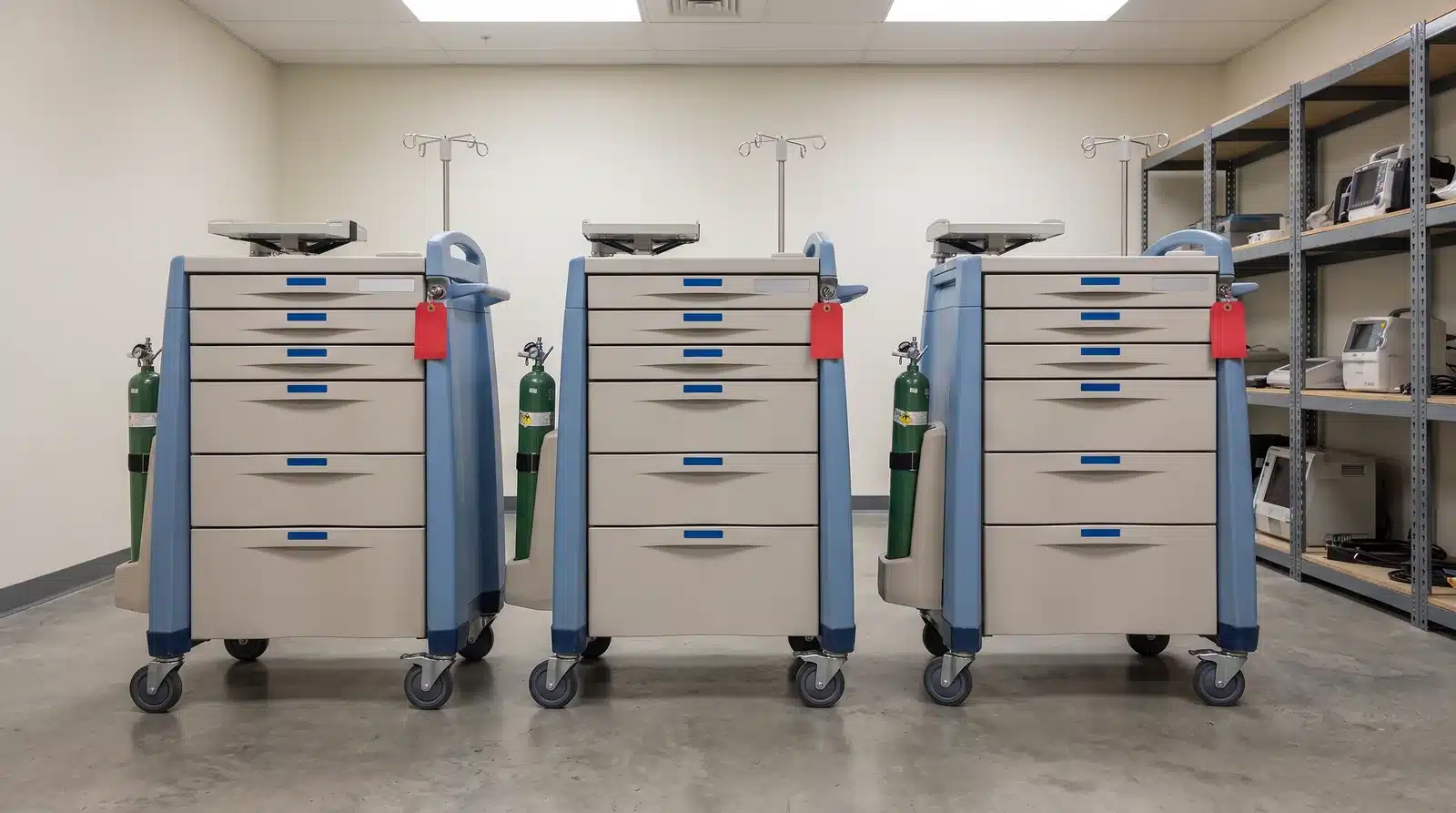
One replacement cart does not reach $139,000. A unit wide or site wide fleet replacement very likely does, and that changes the timeline from weeks to months. Scope the purchase before you shortlist, not after.
Group purchasing organizations are the other route, and we should disclose our own position here: LIOMAR Medical is a member of HealthPRO Canada’s Innovation Accelerator program. HealthPRO states it serves more than 2,000 health care facilities and runs a capital equipment portfolio, and Mohawk Medbuy reports over $3 billion of spend under contract for hundreds of Canadian hospitals. Buying from an existing GPO agreement changes the work your facility has to do, because the competitive process has already been run upstream.
How Fast Can Your Team Reach the Defibrillator?
The clinical constraint that governs a crash cart is not storage volume. It is time to first shock.
For adult in-hospital cardiac arrest, the guideline is defibrillation within two minutes. In the registry study most often cited on this point, delayed defibrillation occurred in 30.1% of cases, and survival to hospital discharge was materially lower in that group, with a dose response decrement for each additional minute of delay (Chan et al., Delayed Time to Defibrillation after In-Hospital Cardiac Arrest, New England Journal of Medicine, 2008).
The pediatric picture is different, and it is worth knowing before someone quotes adult data at you in a specification meeting. In a study of 477 pediatric in-hospital arrests with a shockable rhythm, time to defibrillation was not associated with survival: 39% survived when shocked within two minutes versus 34% when delayed, a difference that did not reach significance (Hunt, Duval-Arnould, Bembea et al., JAMA Network Open, 2018).
Be careful with one more number. The widely quoted figure of roughly 60,000 cardiac arrests a year in Canada, with about one in ten surviving, comes from Heart and Stroke and describes out of hospital arrest. It does not describe the population your crash cart serves.
Here is the honest limit of the evidence, because you will not read it in a vendor brochure. We found no published study linking crash cart design, drawer layout, or cart retrieval time to survival. The two minute window is the constraint that is measured. Whether a given cart adds seconds to it is a reasonable thing to test in your own corridors during a mock code, and it is not something any supplier can prove for you on paper.
How Should Drawer Configuration Match the Unit?
Accreditation Canada’s Required Organizational Practice on concentrated electrolytes, as reproduced in Health PEI’s medication management materials, is the rule that actually reaches into the drawers. Its position is that concentrated electrolytes are not stocked in patient service areas, and where an exception is granted it requires approval by the Drug and Therapeutics Committee, limited quantities, and regular audits.
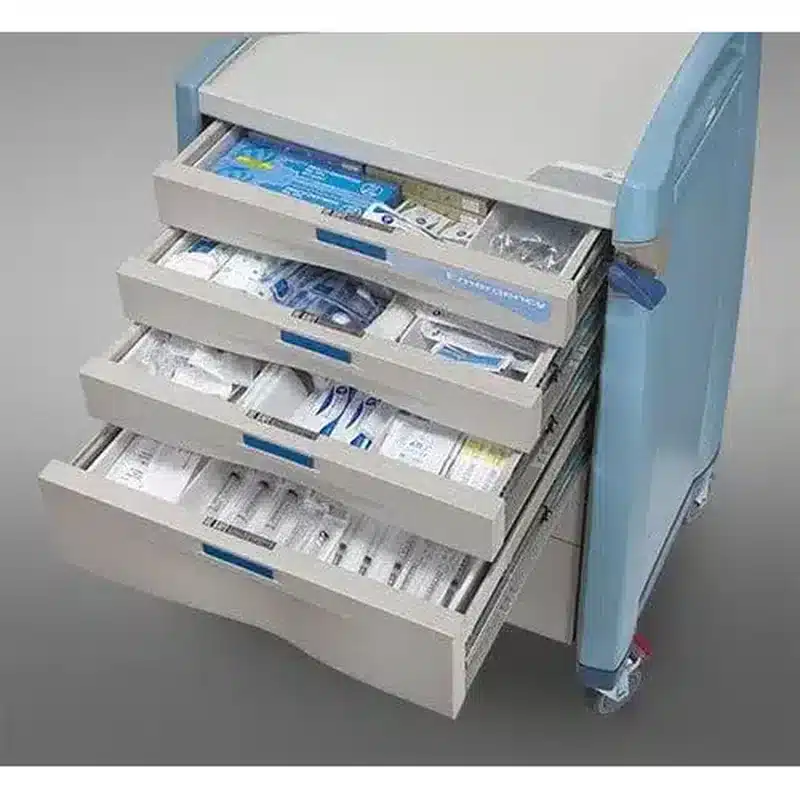
That single requirement drives three specification decisions:
- Segregation. You need a compartment that can be physically separated and audited, not just a labelled tray.
- Auditability. Seals and access records have to survive a surveyor asking who opened what and when.
- Quantity control. Drawer sizing should make overstocking awkward rather than convenient.
Beyond that, configuration follows the unit. An emergency department cart and a rural inpatient unit cart face different arrest frequencies, different restocking distances, and different staffing. Our article on crash cart standardization in rural Canadian hospitals covers the ACLS drawer inventory and inspection routine in detail, so this guide does not repeat it.
What Changes in Long-Term Care
A long-term care home is not a small hospital. Specifying its emergency cart as though it were one produces the wrong cart.
Arrests are less frequent, which sounds like it should simplify the decision. It does the opposite. A cart that is opened rarely is a cart whose expiry dates and seal integrity depend entirely on a scheduled check rather than on daily use, so auditability and clear seal visibility matter more here than in an emergency department, not less.
Staffing differs too. Many Canadian homes run overnight with a small licensed team and rely on an EMS response for definitive care, which means the cart’s job is to support the first several minutes rather than a full in-house code. Goals of care add a further layer: a meaningful share of residents have directives that change what the response looks like, and provincial rules on that vary.
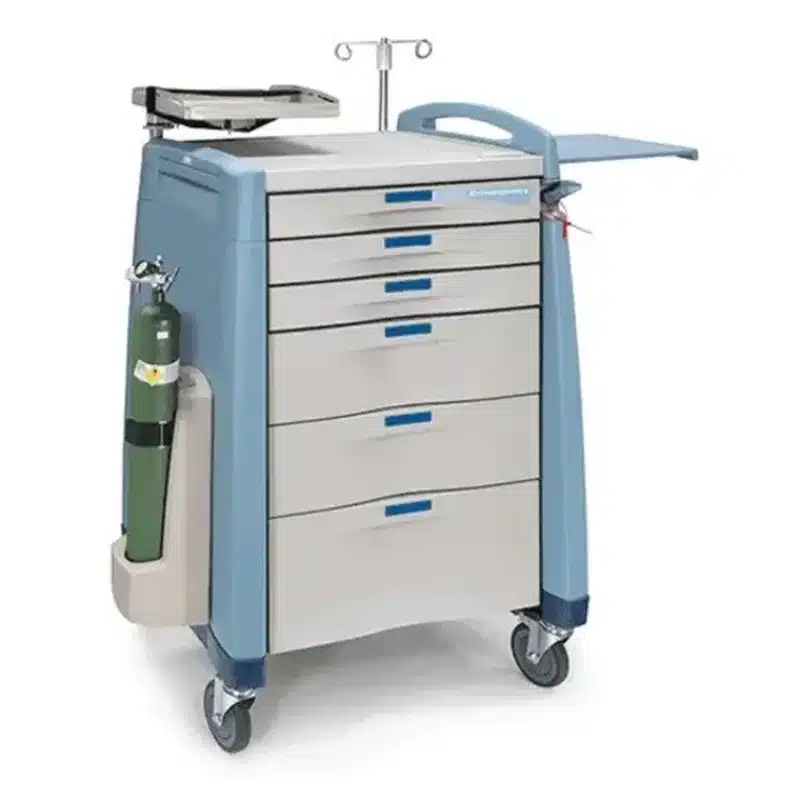
Our crash cart range is built around that constraint. Practically, it argues for a smaller footprint that clears narrow resident room doorways, a layout the same staff can work without hesitation at three in the morning, and a restocking arrangement that does not assume an on-site pharmacy. Where a home runs several floors or buildings, standardizing one configuration across all of them is worth more than optimizing any single cart.
Breakaway Seals or Electronic Locks?
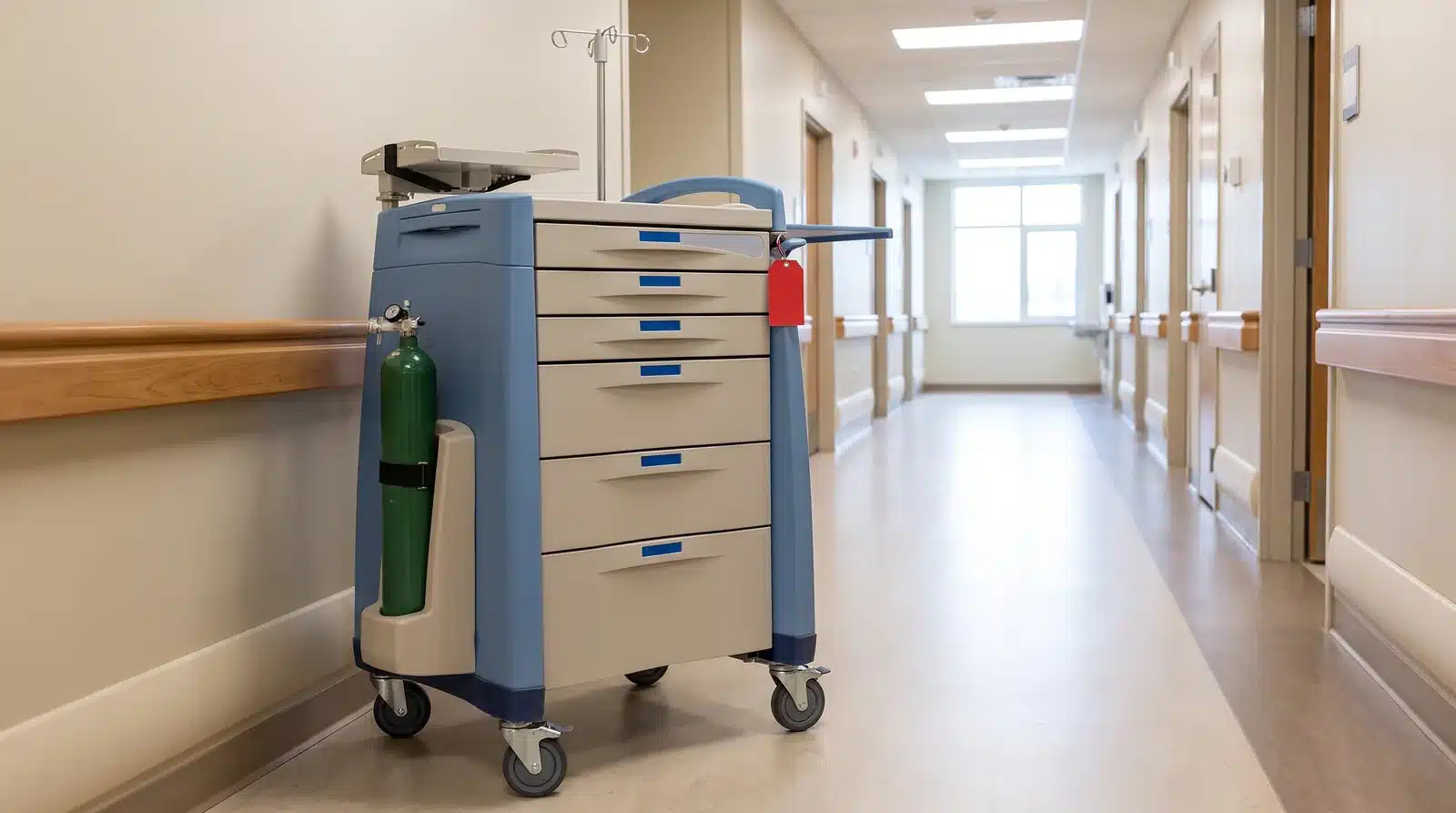
Ask this question and most vendors will answer with a feature list. The honest answer is that we could find no comparative study. We located no published data comparing diversion rates, code response times, or cost between breakaway seal carts and electronic access carts.
Network-connected carts do change the terms of that trade-off, and it is worth knowing before treating it as a binary. A cart that logs access electronically can produce an audit trail without putting a lock between a nurse and a drawer, which is the part that matters at the moment of an arrest. That makes the dilemma more manageable rather than resolving it. The evidence that one approach outperforms the other still does not exist.
What can be said is structural. Crash carts use breakaway or tamper evident seals precisely because at the moment of an arrest, speed outranks security. That is the opposite trade-off from an automated dispensing cabinet, where security outranks speed. Applying dispensing cabinet logic to a crash cart inverts the priority that makes the cart work.
The Avalo Crash Cart we distribute uses a breakaway lock for exactly that reason. Drug loss and theft are a documented problem in Canadian health systems, which is why the question comes up. Roughly 65,000 reports of opioid loss were filed in Canada between 2012 and 2017, amounting to about 112 kilograms (HumanEra research published in CMAJ Open, reported by the University of Toronto, 2023). But that literature concerns pharmacy handling and dispensing cabinets. It is not crash cart evidence, and it should not be used to justify locking down a resuscitation cart.
What to Specify for Cleaning, and What to Ignore
Specify for cleanability. Non-porous surfaces, seamless joints, no crevices that trap soil, and chemical resistance to the disinfectant your facility actually uses, not the one in the vendor’s test report. This is uncontested and it is where the durable value sits.
Treat antimicrobial coatings as an unproven premium.
The best-powered meta-analysis available, a 2020 review of copper-impregnated hospital linen, found a pooled incidence rate ratio of 0.66 against healthcare-associated infections, with a 95% confidence interval running from 0.28 to 1.58 and a p value of 0.36. The interval crosses 1.0, which means no significant effect. The authors described the evidence as conflicting and the overall study quality as not high, with blinding in only two of six studies.
The impressive numbers you will be shown measure something else. One 2022 study reported a 95.5% reduction in aerobic bacterial load on copper-coated bed rails, which is a real result, but it measured surface bioburden and collected no patient infection data at all (AMB Express, 2022).
That gap is the test to apply. When a supplier claims an antimicrobial surface reduces infection, ask for the clinical endpoint rather than the colony count. If the answer is a CFU reduction, you have been shown a proxy, not an outcome.
What Total Cost of Ownership Actually Includes
Published service life and total cost figures for medical carts come almost entirely from vendor marketing with no stated methodology, so this guide will not quote any. The categories, however, are uncontroversial and you can price them against your own facility’s records:
- Acquisition, including freight and duty on imported units
- Maintenance, including caster replacement, which is the most common wear item on a heavily moved cart
- Consumables, including the seals or tags consumed at every restock
- Downtime, meaning what happens to the unit while a cart is out of service
- Training, which is where standardizing on one model across a site pays back, because staff moving between units meet the same drawer layout
- Disposal or refurbishment at end of life
Standardization across a site is usually the largest lever in that list, and it is a procurement decision rather than a product feature. For a broader comparison across cart types, see our guide on how to choose the right medical cart.
Frequently Asked Questions
Can you buy a crash cart through a GPO contract instead of running a tender?
Often yes. Group purchasing organizations such as HealthPRO Canada and Mohawk Medbuy run the competitive process upstream, so buying from an awarded agreement can satisfy the obligation without a facility-level tender. Confirm the specific cart is on contract, and confirm your facility is a signed member.
Does a crash cart need a Health Canada licence?
It depends on classification. Health Canada requires licences for Class II, III and IV devices and advises purchasers to verify licences in the Medical Devices Active Licence Listing before buying. A basic unpowered cart may fall outside licensing, while powered configurations and the Class II or higher devices stocked on it do not.
How much does a crash cart cost in Canada?
There is no published Canadian price benchmark. Group purchasing organization contract pricing is confidential to members, and public tender awards rarely itemize unit cost. United States catalogue list prices exist but omit duty, freight and contract discounts, so converting them gives a misleading figure.
When does a crash cart purchase require a public tender?
Under the Canadian Free Trade Agreement, publicly funded health entities face covered procurement obligations at $139,000 and above for goods, effective 1 January 2026. A single cart falls well below that. A fleet replacement across a site typically does not, so scope the total purchase value before starting.
Are antimicrobial cart surfaces worth paying for?
The clinical evidence does not currently support a premium. The best-powered meta-analysis available, covering copper-impregnated hospital linen, found no statistically significant reduction in infections, and we found no equivalent trial for hard cart surfaces. Studies reporting large bacterial load reductions measured surface contamination, not patient infections.
The Bottom Line
The crash cart decision that matters is made before anyone opens a catalogue.
- Scope the purchase value first. Crossing $139,000 changes the process, not just the paperwork.
- Verify device licences in MDALL yourself. Health Canada places that duty on the purchaser.
- Let the concentrated electrolytes requirement drive drawer segregation, because that is the rule a surveyor will actually test.
- Time your own retrieval during a mock code. It is one of the few crash cart performance numbers anyone can produce honestly.
- Specify cleanability, and ask antimicrobial vendors for infection outcomes rather than colony counts.
Facilities reviewing their emergency cart fleet can start by counting how many carts are due for replacement in the same budget year. That number, multiplied by unit cost, tells you which procurement path you are on before you have committed to anything.
Browse our full medical cart range, or get in touch if you are scoping a replacement across several sites.
About the Author
Mario P. Cloutier is co-founder and CEO of LIOMAR Medical Inc., a Montreal-based manufacturer and distributor of medical equipment for bedridden patients, long-term care residents, and people with reduced mobility. He founded the life sciences sales and marketing agency Xclamat!on in 2002 and has worked with Fortune 500 organizations across the healthcare sector. LIOMAR Medical is a member of the HealthPRO Canada Innovation Accelerator program, which connects manufacturers to more than 2,000 Canadian health facilities.
Connect on LinkedIn · Learn more about LIOMAR Medical
Sources
- Canadian Free Trade Agreement Secretariat. Article 504: Scope and Coverage, Covered Procurement Thresholds, effective 1 January 2026 to 31 December 2027. Retrieved 2026-09-16. www.cfta-alec.ca/wp-content/uploads/2025/11/Article-504.3-Covered-Procurement-Thresholds-Effective-January-1-2026.pdf
- Health Canada. Purchase of Licensed Medical Devices for Use in Health Care. Last modified 18 March 2021. Retrieved 2026-09-16. www.canada.ca/en/health-canada/services/drugs-health-products/medical-devices/licences/purchase-licensed-medical-devices-use-health-care.html
- Accreditation Canada, Medication Management Standards v.15, reproduced by Health PEI. Required Organizational Practice: Concentrated Electrolytes. September 2021. Retrieved 2026-09-16. src.healthpei.ca/sites/src.healthpei.ca/files/Accreditation/ROP_What_are_Concentrated_Electrolytes.pdf
- Chan PS, Krumholz HM, Nichol G, Nallamothu BK. Delayed Time to Defibrillation after In-Hospital Cardiac Arrest. New England Journal of Medicine, vol. 358, no. 1, pp. 9-17, 2008. Retrieved 2026-09-16. pubmed.ncbi.nlm.nih.gov/18172170
- Hunt EA, Duval-Arnould JM, Bembea MM, et al. Association Between Time to Defibrillation and Survival in Pediatric In-Hospital Cardiac Arrest With a First Documented Shockable Rhythm. JAMA Network Open, 2018. Retrieved 2026-09-16. pmc.ncbi.nlm.nih.gov/articles/PMC6324599
- Heart and Stroke Foundation of Canada. Every second counts: Transforming resuscitation to restart more hearts. 31 January 2024. Retrieved 2026-09-16. www.heartandstroke.ca/what-we-do/media-centre/news-releases/more-cardiac-arrests-are-occurring-and-few-survive
- Fan M, Shao X, Wang J, Ren R. Efficacy of copper-impregnated hospital linen in reducing healthcare-associated infections: A systematic review and meta-analysis. PLOS ONE, 2020. Retrieved 2026-09-16. journals.plos.org/plosone/article?id=10.1371/journal.pone.0236184
- Blehm CJ, et al. Copper-coated hospital surfaces: reduction of total bacterial loads and resistant Acinetobacter spp. AMB Express, 2022. Retrieved 2026-09-16. pmc.ncbi.nlm.nih.gov/articles/PMC9684398
- Trbovich P, Fan M. Researchers develop tool to help hospitals reduce loss and theft of medications. HumanEra, University of Toronto, published in CMAJ Open. 13 June 2023. Retrieved 2026-09-16. www.utoronto.ca/news/researchers-develop-tool-help-hospitals-reduce-loss-and-theft-medications
- HealthPRO Canada. About Us. Retrieved 2026-09-16. www.healthprocanada.com/about-us
- Mohawk Medbuy Corporation. About. Retrieved 2026-09-16. www.mohawkmedbuy.ca/about