Crushing a tablet can destroy up to 13.7% of the prescribed dose before it ever reaches the resident (Thong, Manrique and Steadman, Drug loss while crushing tablets: Comparison of 24 tablet crushing devices, PLoS One, 2018). In a long-term care home where most residents take ten or more medications daily, that loss compounds across every cart, every shift, every day.
This article covers what actually goes wrong during crushed medication administration in Canadian long-term care, what the research says about device performance, and what to evaluate before standardizing on an automated pill crusher.
Key Takeaways
60.9% of Canadians aged 65+ living in long-term care take 10 or more prescription drugs, versus 26.1% of seniors at home (CIHI, 2014).
More than 30% of long-term care residents live with dysphagia, which is why crushing is routine rather than exceptional.
Roughly 38% of residents who received crushed medications received at least one drug that should not have been crushed.
Crushing aerosolizes drug particles, and most of that exposure happens at the pour, not the crush (Journal of Occupational and Environmental Hygiene, 2025).
Device choice changes dose delivery: drug loss ranged from 1.89% to 13.69% across 24 crushers tested.
Why Is Pill Crushing So Common in Long-Term Care?
More than 30% of residents in skilled nursing and long-term care facilities live with dysphagia, compared with 11 to 14% of community-dwelling adults over 65 (Pharmacy Times, To Crush or Not to Crush). Difficulty swallowing is not an edge case in these settings. It is the baseline condition for roughly one resident in three.
Add polypharmacy and the volume becomes clear. In Canada, 60.9% of seniors living in long-term care take 10 or more different prescription drugs, more than double the 26.1% rate among seniors living at home (Canadian Institute for Health Information, reported in CMAJ, 2014).
Ten medications, one resident with dysphagia, thirty residents on a unit. The math produces hundreds of crushing events per home per day, each one a small procedure with its own failure modes.
For a broader look at how equipment choices affect frontline staff, see our article on how advanced medical equipment boosts healthcare workforce productivity.
What Goes Wrong When Medications Are Crushed Manually?
Crushing a tablet that should not be crushed is itself a medication error, and it happens often. Roughly 38% of residents who received crushed medications received at least one drug considered inappropriate to crush (Pharmacy Times, To Crush or Not to Crush).
The consequences depend on the formulation. Crushing an extended-release tablet delivers the entire dose at once instead of over hours. Crushing a delayed-release tablet strips the coating that protects the drug from gastric acid, or protects the stomach lining from the drug. Neither failure announces itself at the bedside.
Beyond the wrong-drug problem, manual crushing introduces three mechanical risks:
Dose loss. Powder stays trapped in serrations, on pestles, and inside crushing bags. It never reaches the resident.
Cross-contamination. When a mortar and pestle is reused across residents, residue from the previous dose travels with it. Traces of one resident’s medication end up in another’s cup.
Repetitive strain. Hand-twist devices demand grip force many times per med pass. Over a career, that adds up to a documented musculoskeletal risk for nursing staff.
What the incident reports miss: ISMP Canada analyzed 86 medication error reports from Ontario long-term care homes between July 2021 and May 2023. Omission was the most common error type at 30%, and some level of harm was reported in 23% of cases. Partial dose loss from crushing rarely gets reported at all, because nobody observes it. It looks like a normal administration.
Interruptions make everything worse. A 2025 scoping review found that 73% of studies reported a statistically significant positive association between interruptions and medication administration errors (Schroers et al., Journal of Advanced Nursing, 2025). A med pass that requires two hands and thirty seconds of physical effort per tablet is a med pass built for interruption.
How Much of the Dose Actually Reaches the Resident?
Researchers tested 24 tablet crushing devices and measured recovery of 86.3% to 98.1% of the original powder, an average loss of 5.8% across all devices (Thong, Manrique and Steadman, PLoS One, 2018). The spread between the best and worst performers matters more than the average.
Mortar-and-pestle designs performed best on recovery alone, losing between 1.89% and 4.08%. Hand-twist devices with serrated surfaces performed worst, with a crushing syringe losing 13.69% and others in the 5.35 to 7.74% range as powder lodged between the teeth. Disposable bag systems ranged from 2.1% to 13.3%.
There’s a catch in that ranking. The mortar and pestle recovers the most powder and creates the most cross-contamination, because it is reused. Recovery and containment pull in opposite directions with traditional tools. That tension is precisely what an enclosed automated system is built to resolve.
The study also found that rinsing technique matters: a single water rinse lost an average 24.2% of the dose, while two consecutive rinses brought loss back down to 4.2%. Staff technique, not just the device, determines what the resident receives.
Is Crushing Medication a Risk to Staff?
Crushing oral tablets aerosolizes active pharmaceutical ingredients and exposes healthcare workers to airborne drug particulates (Journal of Occupational and Environmental Hygiene, 2025). This is an occupational exposure question, not only a resident safety question.
The 2025 study produced one finding worth changing practice over: most of the aerosolized particulate was generated not during crushing itself, but when the crushed tablet was poured from its container into a cup of water. The exposure happens at the transfer step.
Recommended control measures include substituting liquid formulations where available, having the pharmacy pre-crush, limiting vigorous pouring, and fit-tested N95 respirators. Most Canadian long-term care homes cannot implement the first two at scale. That leaves engineering controls on the device itself.
Why SafeCrush is built for containment: its enclosed crushing chamber is not about speed. It addresses the two failure points the literature keeps identifying: airborne dust at the transfer step, and residue carried between residents.
An enclosed automated crusher keeps the powder contained from crush to cup. It also removes the grip force that drives repetitive strain claims among nursing staff, and eliminates the reused mortar that carries residue from one resident to the next.
What Should Long-Term Care Homes Evaluate Before Standardizing?
Procurement teams comparing pill crushers get better outcomes when they evaluate six criteria rather than unit price alone. Each maps to a documented failure mode above.
Dose recovery. Ask what percentage of powder the device delivers. Anything above 5% loss is measurable under-dosing at scale.
Containment. Confirm the crushing chamber is enclosed and that transfer to the cup does not require vigorous pouring.
Cross-contamination control. Determine whether any component is reused between residents without cleaning, and what the cleaning protocol requires.
Ergonomics. Count the grip actions per med pass. Automated crushing removes them entirely.
Noise. Med passes happen during rest hours in resident corridors. A quiet device is a clinical requirement, not a comfort feature.
Power and uptime. Battery-operated units need runtime that covers a full med pass without a mid-round charge.
Standardization matters as much as the device. When every cart in the home uses the same crusher with the same protocol, technique variation drops and training simplifies. The same logic drives crash cart standardization in rural Canadian hospitals, and it applies just as directly to the medication cart.
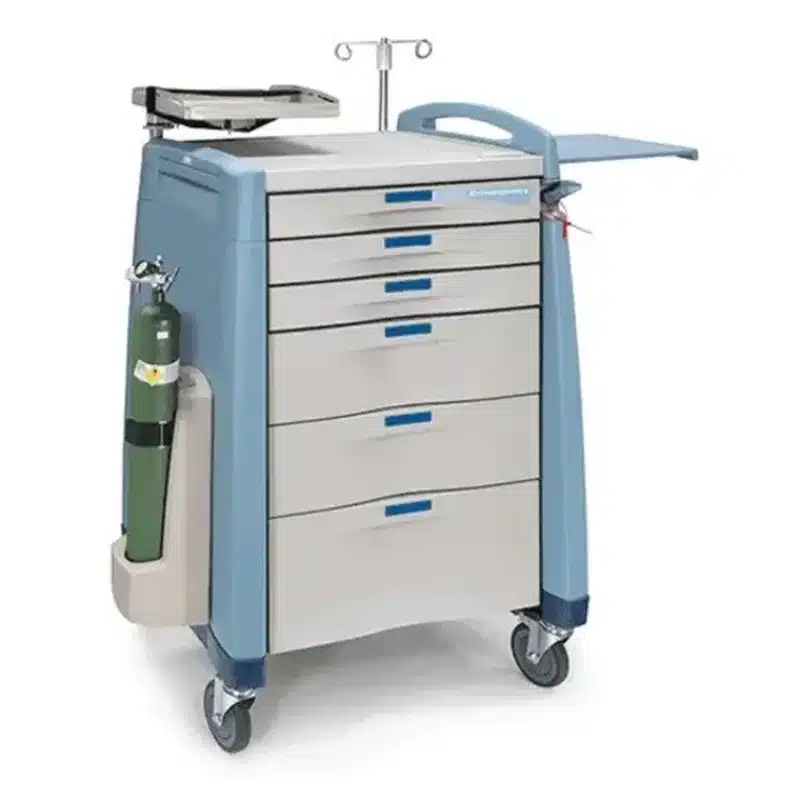
Crushing equipment should also be specified alongside the cart itself. See our Avalo medication carts for configurations with secure drawer storage and workspace designed for the med pass.
How Does an Automated Pill Crusher Change the Med Pass?

An automated crusher replaces a thirty-second two-handed manual operation with a single button press. That reclaimed time returns to the resident interaction, which is where interruptions currently create risk.
SafeCrush crushes tablets to a fine powder in an enclosed chamber, operates on a rechargeable 12V battery, and runs at a low noise profile suitable for resident corridors. It is designed to prevent double pouring, eliminate airborne pill dust, and remove the repetitive grip motion that manual crushers require. It carries a 3-year warranty and is in use in more than 15 countries.
The strongest argument is not speed. It’s consistency. A manual crusher produces a different result depending on who is holding it, how tired they are, and whether they were interrupted mid-crush. An automated device produces the same result every time, which is the definition of a controlled process in a setting where 23% of reported medication incidents involve some level of harm.
Ready to Standardize Your Med Pass?

LIOMAR Medical manufactures and distributes equipment built for the realities of Canadian long-term care: enclosed automated pill crushing, secure medication carts, and precision measurement at the bedside.
Book a free demonstration and we’ll walk through dose recovery, containment, and cleaning protocol for your home.
Frequently Asked Questions
How much medication is lost when a tablet is crushed?
Across 24 devices tested, recovery ranged from 86.3% to 98.1%, an average loss of 5.8% (PLoS One, 2018). Mortar-and-pestle designs lost 1.89% to 4.08%. Hand-twist devices with serrated surfaces lost up to 13.69% as powder lodged between the teeth.
Which medications should never be crushed?
Extended-release and delayed-release formulations should not be crushed, since crushing delivers the full dose at once or removes protective coatings. Consult the ISMP Do Not Crush list before altering any oral solid. Roughly 38% of residents receiving crushed medications got at least one drug inappropriate to crush.
Is crushing pills a health risk for nurses?
Yes. Crushing aerosolizes active drug ingredients and exposes staff to airborne particulates (Journal of Occupational and Environmental Hygiene, 2025). Most exposure occurs when pouring crushed powder into a cup of water. Enclosed automated crushers reduce this transfer-step exposure.
Why do so many long-term care residents need crushed medication?
More than 30% of long-term care residents live with dysphagia, and 60.9% of Canadian seniors in long-term care take 10 or more prescription drugs versus 26.1% of those at home (CIHI, 2014). The combination makes crushing a routine daily task rather than an exception.
What does SafeCrush do differently from a manual crusher?
SafeCrush crushes tablets to a fine powder in an enclosed chamber at the press of a button. It eliminates airborne pill dust, prevents double pouring, removes the repetitive grip motion of hand-twist devices, and runs quietly on a rechargeable 12V battery. It includes a 3-year warranty.
The Bottom Line
Crushed medication administration is one of the highest-volume, lowest-scrutiny procedures in Canadian long-term care. It happens hundreds of times a day per home, and its failure modes are largely invisible.
Dose loss ranges from under 2% to nearly 14% depending on the device, and nobody at the bedside can see the difference.
Reused crushing tools carry residue between residents, and the tools that recover the most powder are often the ones that get reused.
Staff exposure to aerosolized drug particles peaks at the pour, not the crush.
Standardizing on one enclosed automated device removes technique variation across carts, shifts, and staff.
Homes reviewing their medication administration protocol should start by counting how many crushing events happen per day, then multiply by the loss rate of their current device. The number is usually larger than expected.
About the Author
Mario P. Cloutier is co-founder and CEO of LIOMAR Medical Inc., a Montreal-based manufacturer and distributor of medical equipment for bedridden patients, long-term care residents, and people with reduced mobility. He founded the life sciences sales and marketing agency Xclamat!on in 2002 and has worked with Fortune 500 organizations across the healthcare sector. LIOMAR Medical is a member of the HealthPRO Canada Innovation Accelerator program, which connects manufacturers to more than 2,000 Canadian health facilities.
Sources
Thong MY, Manrique YJ, Steadman KJ. Drug loss while crushing tablets: Comparison of 24 tablet crushing devices. PLoS One, vol. 13, no. 3, e0193683, 1 March 2018. Retrieved 2026-08-05. pmc.ncbi.nlm.nih.gov/articles/PMC5832315
Journal of Occupational and Environmental Hygiene. Healthcare workers’ exposure to aerosolized medications while crushing oral tablets. 2025. Retrieved 2026-08-05. tandfonline.com 6 aerosolized medications while crushing
Canadian Institute for Health Information, reported in CMAJ. Two-thirds of seniors in long-term care take 10 or more drugs. CMAJ, vol. 186, no. 9, E309, 2014. Retrieved 2026-08-05. cmaj.ca/content/186/9/E309
Pharmacy Times. To Crush or Not to Crush: That is the Medication Administration Question. Retrieved 2026-08-05. pharmacytimes.com 6 To Crush or Not to Crush
ISMP Canada. Reporting and Learning in Ontario Long-Term Care Homes: A Multi-Incident Analysis of Medication Incidents. Retrieved 2026-08-05. ismpcanada.ca 6 Ontario LTC multi-incident analysis
Schroers G, et al. Associations Between Interruptions and Medication Administration Errors Among Nurses in Hospital Settings. Journal of Advanced Nursing, 2025. Retrieved 2026-08-05. onlinelibrary.wiley.com/doi/10.1111/jan.70032
Institute for Safe Medication Practices. Crushing or splitting the wrong tablet can be dangerous. ISMP Long-Term Care Advise-ERR. Retrieved 2026-08-05. ismp.org 6 LTC Advise-ERR (PDF)