Medical Cart Buying Guide: Prioritizing Your Team and Your Patients
In the middle of a frantic shift, a medical cart shouldn’t just be “equipment on wheels”—it should be your most reliable teammate. We know that in a high-pressure ward, a sticky drawer or a heavy, clunky frame isn’t just an inconvenience; it’s a barrier that stands between a clinician and their patient. Choosing the right cart is about more than storage—it’s about protecting your staff from burnout and ensuring that medication security is one less thing they have to worry about.
At LIOMAR we’ve spent years walking the halls of hospitals and clinics, watching how care actually happens. We know that every facility has its own rhythm and its own challenges. Our philosophy is simple: your equipment should adapt to your team, not the other way around.
We’ve poured everything we’ve learned about ergonomics and frontline reality into this guide to help you find the perfect fit for your facility’s unique DNA.
To choose the right medical cart for your healthcare facility, consider the following factors:
- Facility Type: Identify whether you need a cart for a hospital, long-term care, rehabilitation, or pharmacy.
- Patient Volume and Medication Load: Assess how many patients you serve and the volume of medications you handle.
- Drawer Capacity and Organization Needs: Determine the storage requirements based on the types of medications and supplies you need to store.
- Security Requirements: Ensure the cart meets any necessary security standards, especially for narcotics or controlled substances.
- Space and Mobility Constraints: Evaluate the physical space available and the mobility needs within your facility.
Larger centers may require high-capacity carts, while smaller units might benefit from more compact models.
What Are the Different Types of Medical Carts and Their Uses?
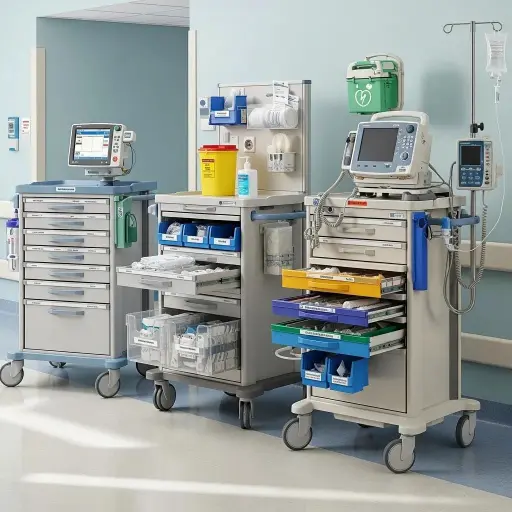
The different types of medical carts and their uses include:
- Medication carts – for storing and administering medications.
- Treatment carts – for wound care, procedures, and supplies.
- Crash carts (emergency carts) – for emergency response and resuscitation.
- Procedure carts – for clinical procedures and examinations.
- Computer workstations on wheels (WOWs) – for EMR/EHR documentation.
- Isolation carts – for infection control and PPE storage.
Leading manufacturers like Capsa Healthcare provide a comprehensive range of these specialized carts, each engineered to support specific clinical workflows and care environments.
How Do Anesthesia, Medication, and Crash Carts Differ in Function?
Anesthesia, medication, and crash carts differ in function as follows:
- Anesthesia Carts: These are specialized carts used to store anesthesia drugs, equipment, and supplies necessary for administering anesthesia during surgical procedures. They are designed to support anesthesiologists by organizing medications and tools required for anesthesia care.
- Medication Carts: These are mobile units used for storing and administering medications. They are designed to improve medication safety, reduce errors, and streamline nursing workflows.
- Crash Carts: These are emergency carts equipped with supplies and medications necessary for resuscitation and emergency response. They are used in critical situations to provide immediate care.
Each type serves a distinct purpose in healthcare settings.
What Are the Specific Applications of Mobile Computing and Isolation Carts?
The specific applications of mobile computing and isolation carts include:
Mobile Computing:
Prominent providers such as Capsa Healthcare specialize in highly configurable computer workstations on wheels (WOWs), known for their robust design and seamless integration with EMR/EHR systems, thereby enhancing workflow and supporting healthcare professionals in delivering safe, effective patient care.
Isolation Carts:
Designed for infection control and storage of personal protective equipment (PPE).Supports clinical workflows by providing necessary supplies for infection prevention in healthcare settings.
These applications help improve efficiency and safety in healthcare environments.
What Key Features Should You Consider When Selecting a Medical Cart?
When selecting a medical cart, consider the following key features:
Facility Type
Determine if the cart is suitable for a hospital, long-term care, rehabilitation, or pharmacy
Patient Volume and Medication Load:
Assess the expected patient volume and the amount of medication that needs to be stored.
Drawer Capacity and Organization Needs:
Evaluate the required drawer sizes and organization configurations.
Security Requirements:
Ensure the cart has secure locking mechanisms, especially for controlled substances.
Space and Mobility Constraints:
Consider the available space and the mobility needs of the cart within the facility.
Accessory Options:
Look for included and optional accessories that can enhance functionality, such as organizers, keyless access, and bulk storage options.
How Do Durability, Mobility, and Ergonomics Impact Cart Performance?
Durability, mobility, and ergonomics significantly impact the performance of medical carts.
Durability:
High-quality materials ensure that carts withstand daily use in busy healthcare environments, reducing the need for frequent replacements.
Mobility:
Carts equipped with premium casters allow for easy maneuverability, which is essential in fast-paced settings where time is critical.
Ergonomics:
Well-designed carts promote user comfort and efficiency, reducing strain on healthcare workers during use.
Further research emphasizes the critical role of ergonomic design in mitigating physical strain for healthcare professionals.
Navigating the “Tight Squeeze”: Space and Mobility in Canadian Facilities
Choosing a cart isn’t just about what fits inside the drawers; it’s about what fits through the doorway. In many Canadian healthcare settings—from heritage hospital wings in Ontario to busy long-term care homes in BC—space is the ultimate luxury.
The “Footprint” Factor
In 2026, we are seeing a shift toward “Slim-Profile” engineering. High-capacity carts no longer have to be bulky. At LIOMAR, we recommend assessing your facility’s “choke points”:
- Narrow Hallways: Look for carts with a depth of 24 inches or less to allow two carts to pass each other safely.
- Bedside Maneuverability: Does the cart have a “Zero-Radius” turn? This allows a nurse to pivot the cart 360 degrees in place—essential for cramped 4-bed ward rooms.
Mobility That Protects Your Staff
Mobility is the #1 factor in preventing nurse fatigue. We look for three specific mobility features in our lineup:
- Directional Tracking Casters: One “master” caster that locks into a straight line for long hallway hauls, then switches to full swivel for precise bedside positioning.
- Low-Push-Force Design: By using lightweight aluminum frames (like those in the Capsa M-Series), we reduce the initial force required to move a cart by over 30%, directly lowering the risk of musculoskeletal injuries.
- The “Vertical” Advantage: When floor space is gone, look up. Many LIOMAR solutions utilize vertical modularity—stacking storage higher without widening the base.
LIOMAR Pro-Tip: Don’t forget the “Vibration Factor.” In 2026, we prioritize precision ball-bearing casters. Why? Because a cart that rattles and vibrates while moving through a quiet night-shift unit isn’t just annoying—it’s a disruption to patient recovery.
These factors collectively enhance the overall effectiveness of medical carts in delivering patient care.
What Security and Technology Integrations Enhance Medical Cart Efficiency?
Security and technology integrations that enhance medical cart efficiency include:
- Secure Locking Mechanisms: Essential for storing controlled substances, these include key locks, keyless access (code-based), and automatic relocking systems—features often exemplified by leading brands like Capsa Healthcare—which help comply with regulatory standards and protect patient safety.
- Customizable Storage Options: Integrated divider systems and various drawer configurations support organized medication storage and accommodate different medication workflows.
- Mobility Features: Premium casters with brakes and optional tracking casters enhance maneuverability and stability, making it easier to transport the carts within healthcare facilities.
- Infection Control Features: Smooth surfaces for easy cleaning help support infection prevention protocols.
Compliance You Can Trust: Canadian Standards & Safety
Navigating Canadian healthcare regulations can be complex, but your equipment shouldn’t be. In 2026, “off-the-shelf” isn’t enough. To protect your facility and your patients, we ensure our solutions meet the highest benchmarks:
- CAN/CSA-ISO 9001:2015, 27001:2022: Guarantees that national technical compliance, world-class Quality Management System (QMS), Information Security Management System (ISMS) is behind every process.
- IEC 60601 Series: Crucial for powered carts, ensuring electrical safety and zero interference with bedside medical devices.
- Health Canada Compliance: We help you navigate the Medical Device Establishment Licence (MDEL) requirements, ensuring every product is vetted for the Canadian market.
How Do Materials & Maintenance Extend Medical Cart Lifespan Safely?
The materials used in medical carts and their maintenance significantly affect their longevity and safety.
- Materials: Carts made from stainless steel and antimicrobial surfaces are more durable and easier to clean, which is crucial for infection control.
- Maintenance: Regular cleaning with appropriate disinfectants prevents the spread of infections. Implementing a routine maintenance schedule helps maintain high standards of cleanliness and safety.
How Should You Maintain Medical Carts to Ensure Infection Control?
To maintain medical carts for infection control, it is important to regularly clean them with appropriate disinfectants to prevent the spread of infections.
Additionally, ensuring that the carts have smooth surfaces can aid in infection control. Implementing a routine maintenance schedule can help maintain high standards of cleanliness and safety.
Why Choose LIOMAR Medical Carts for Your Hospital or Healthcare Facility?
As a premier distributor of Capsa Healthcare solutions, LIOMAR combines world-class technical capabilities with local clinical support.Capsa Healthcarel Carts are designed to improve medication safety, reduce medication errors, streamline nursing workflows, support infection prevention, and ensure secure access to medications.
They are ideal for hospitals, bariatric care units, and long-term care facilities, and they help standardize medication delivery across units and shifts. Additionally, they comply with regulatory standards by featuring secure locking mechanisms, especially for controlled substances.
How Do LIOMAR’s Carts Meet Hospital Cart Selection Criteria?
LIOMAR’s carts meet hospital cart selection criteria by incorporating essential features such as:
- Robust Construction: Ensures durability and longevity in high-use environments.
- Customizable Storage: Allows for tailored organization based on specific facility needs.
- Enhanced Security: Features secure locking mechanisms to protect controlled substances.
What Unique Features and Innovations Does LIOMAR Offer?
LIOMAR offers several unique features and innovations, including:
- Wishower Mobile Bathing System: This innovative system (designed and manufactured by LIOMAR in Canada) improves safety, efficiency, and infection control for bathing bedridden patients, reducing cross-contamination and supporting hygiene management.
- Opti-Height Series Measurement Stations: These stations enhance workflow efficiency and patient satisfaction with user-friendly designs that allow for quick assessments and accurate measurements, minimizing errors in patient monitoring.
- Expanded Portfolio: LIOMAR has broadened its range to include evidence-based mobility aids such as wheelchairs, lifts, walkers, and upright walkers, aimed at improving independence and care quality for patients.
- Durable Medical Equipment: Products like the Biobase examination beds feature high-strength steel frames, water-resistant artificial leather covers, and comfortable sponge cushions, ensuring durability and ease of maintenance.
Frequently Asked Questions
What is the typical price range for medical carts, and what factors influence their cost?
Modularity and customization are paramount for optimizing medical cart functionality across various clinical environments. A modular design enables healthcare facilities to adapt carts with interchangeable components, such as different drawer sizes, specialized bins, or accessory mounts, to suit distinct departmental requirements like emergency, pharmacy, or long-term care. This inherent flexibility ensures each cart can be precisely configured for specific workflows and patient needs, significantly enhancing operational efficiency and reducing the necessity for multiple, highly specialized carts. Customization also supports future adaptability as clinical demands evolve, thereby maximizing the longevity and value of the initial investment.
Beyond EMR, what other technology integrations should I consider for modern medical carts?
Modern medical carts offer a range of technology integrations beyond Electronic Medical Records (EMR) to further enhance efficiency and patient safety. Facilities should consider features like biometric authentication for secure access to medications and sensitive patient data, integrated barcode scanners for accurate medication administration, and RFID tracking for real-time inventory management and cart location. Some advanced carts also incorporate telehealth capabilities, enabling remote consultations directly at the patient’s bedside. These sophisticated integrations streamline workflows, minimize human error, and provide immediate data access, fostering a more connected and responsive healthcare delivery system.
What kind of training and support is available for healthcare staff using new medical carts?
Comprehensive training and ongoing support are critical for the successful adoption and effective use of new medical carts. Leading distributors, such as LIOMAR, often collaborate with manufacturers like Capsa Healthcare to provide on-site training sessions. These programs familiarize staff with cart features, security protocols, and technology integrations, including hands-on practice with advanced locking mechanisms, drawer configurations, and mobile computing functionalities. Additionally, access to dedicated technical support, detailed troubleshooting guides, and responsive customer service ensures seamless operation and prompt resolution of any issues, ultimately maximizing staff efficiency and maintaining high standards of patient care.
How can facilities future-proof their medical cart investments against evolving healthcare needs and technologies?
To future-proof medical cart investments, facilities should prioritize adaptable and scalable solutions. Opt for carts with modular designs that allow for easy upgrades or reconfigurations of storage, accessories, and technology components. Selecting carts with open architecture for both software and hardware ensures compatibility with future EMR systems, new medical devices, and emerging digital health solutions. Investing in durable, high-quality materials also extends the cart’s operational lifespan. Furthermore, choosing a vendor that provides continuous support, regular software updates, and a clear upgrade pathway helps facilities seamlessly adapt to evolving clinical workflows and technological advancements, avoiding frequent, costly replacements.
Are there environmentally friendly or sustainable options available for medical carts?
Yes, as sustainability becomes a growing priority in healthcare, environmentally friendly medical cart options are increasingly available. Facilities can seek carts manufactured using recycled or sustainably sourced materials, such as specific types of plastics or aluminum. Some manufacturers integrate energy-efficient power systems into their mobile computing carts, which helps reduce their overall carbon footprint. Additionally, selecting highly durable carts with extended lifespans and components that are easily repairable or recyclable contributes significantly to waste reduction. Inquiring about a manufacturer’s environmental policies and certifications can guide more eco-conscious purchasing decisions.
What factors should I consider when determining the right size of a medical cart?
How can I ensure the medical cart I choose complies with safety regulations?
To ensure compliance with safety regulations, verify that the medical cart meets industry standards for materials, construction, and security features. Look for certifications from relevant health and safety organizations. Additionally, consider carts with secure locking mechanisms for controlled substances and those designed with infection control in mind, such as antimicrobial surfaces. Regularly reviewing and updating your cart selection based on current regulations will also help maintain compliance.