
AVALO PUNCH CARD MEDICATION CART
Capsa Medication Carts for Canadian Healthcare
Medication Carts in Canada
High-Capacity Punch Card Storage Designed for Efficient Clinical Workflows Across Canada
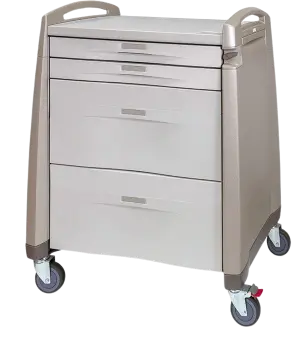
The Avalo Punch Card Medication Cart is a Capsa-built solution designed to support secure medication management in long-term care and skilled nursing facilities across Canada. The Avalo series is engineered for the realities of clinical care, offering effortless drawer access and smooth performance.
Engineered by Capsa Healthcare and distributed by LIOMAR Medical, this medication cart features high-density panels to prevent denting and a precision-welded steel frame. It is compatible with virtually all medication delivery systems, including full and half-size punch cards.
Available in three widths (Small, Large, and XL) to suit facilities of all sizes, with a maximum capacity of up to 750 punch cards.


Avalo Series by Capsa Healthcare
Product Details of the Avalo Punch Card Medication Cart
Designed for the demanding environments of Canadian long-term care, the Avalo combines a rugged steel-reinforced frame with high-impact panels for maximum durability. It provides expansive workspace and flexible organization to streamline the daily medication pass.
- Nursing Homes and Extended Care Facilities
- Assisted Living and Continuing Care Communities
- Long-Term Care (LTC) and Skilled Nursing Facilities
- Rehabilitation Centers and Hospice Care
- Large Capacity: Accommodates between 450 and 750+ punch cards depending on the model size.
- Flexible Organization: Unique integrated drawer divider system and various seamless drawer depths (3", 6", 10").
- Proven Security: Choice of Core Removable locks, Keyless Access, or the AutoLock™ automatic relocking system
- Durability: High-density panels prevent corrosion and denting, supported by a 10-year limited warranty.
- Mechanical Coverage: 10-year parts-only warranty on Avalo LTC/Medication carts.
- Electronics & Locking: 2-year standard coverage for electronic locking systems.
- Component Specifics: Casters are covered under a standard 3-year parts-only warranty.
- Optional Upgrades: For AC Medication carts, there is an optional upgrade available to extend the warranty on Locking Systems & Electronics to 5 years.
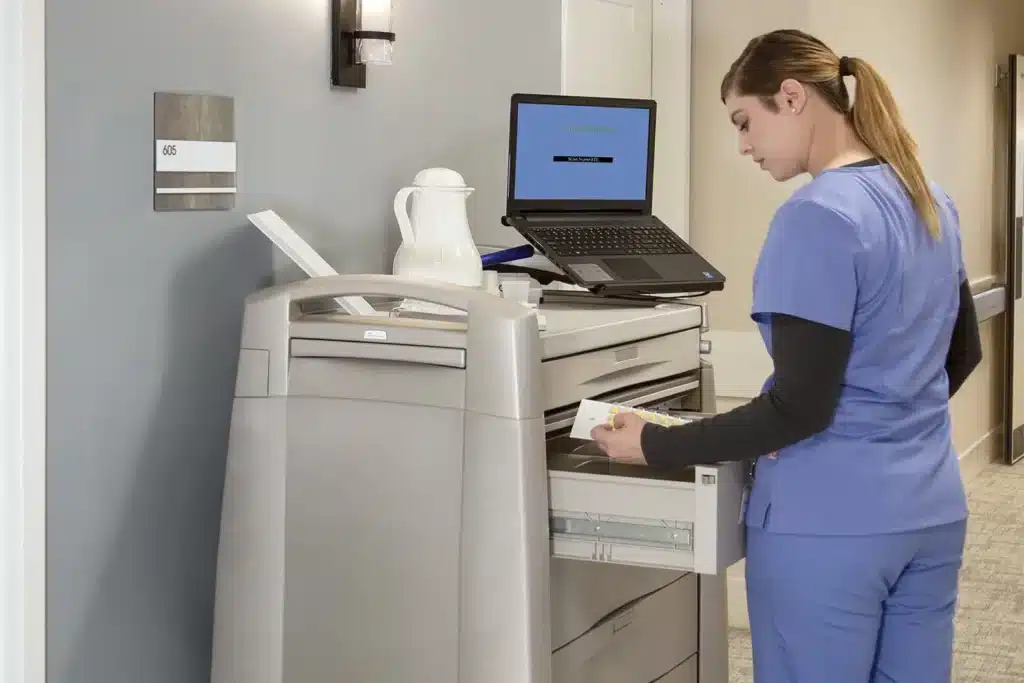
See the Avalo Punch Card Cart in Clinical Use
Serving Healthcare Facilities Across Canada
The Right Cart Configuration for Your Facility
Our team works with you to determine the optimal cart size based on your resident population, medication cycle length, and distribution model — whether restock or exchange.

About Capsa Healthcare
More About the Manufacturer
Capsa Healthcare is a global leader in the design and manufacture of innovative, ergonomic medical carts and medication management solutions. Trusted by healthcare teams across North America, Capsa’s products are engineered to support safe medication administration and streamlined clinical workflows.
Known for purposeful engineering, Capsa has partnered with healthcare teams for over 60 years to solve complex medication delivery challenges.
LIOMAR Medical is proud to be the authorized Canadian distributor of Capsa Healthcare products.
Configure Your Cart
MEDICATION CART CONFIGURATOR
The Avalo Multi-Dose Cart integrates seamlessly with LIOMAR Medical’s broader Capsa medication management offering — including medication room storage, pharmacy workflows, mobile computing, and documentation carts.
Contact our team to configure the right setup for your facility.
1: Select a cart base option

2: Accessories that are included

3: Kits of accessories available

Standard Accessories
Optional Accessories
Related Products
Your Authorized Canadian Distributor
Why Choose LIOMAR Medical?
LIOMAR Medical is a specialized distributor of Capsa Healthcare medication carts and medical equipment across Canada. Our team offers more than just a product — we provide complimentary on-site workflow assessments to ensure the right Capsa cart is configured for your specific facility, hallways, and clinical processes.

Frequently Asked Questions
Multi-Dose Medication Carts & Capsa Carts in Canada
What is a medication cart?
A medication cart is a specialized mobile workstation used by clinicians to securely store, organize, and transport medications within a facility. The Avalo cart specifically supports the daily medication pass in Canadian long-term care homes and hospitals, ensuring that treatments are delivered accurately at the point of care.
What punch cards are compatible with this medication cart?
The Avalo cart is designed to accommodate virtually all punch card (blister pack) delivery systems used in Canada. This includes both full and half-size cards, as well as liquid medications and supplies.
What are Capsa medication carts?
Capsa medication carts are a line of professional medical carts manufactured by Capsa Healthcare, a global leader in clinical workflow solutions.
The Capsa medication cart lineup includes multiple series — including the Avalo series, the M-Series, and the Vintage Encore series — each designed for different medication management systems and care environments.
Capsa medication carts are known for their durable all-steel frames, modular design, multiple locking options, and compatibility with a wide range of medication packaging formats.
In Canada, Capsa medication carts are distributed by LIOMAR Medical, which offers on-site consultation, configuration, and support services.
Are medication carts required to be locked in Canada?
Yes — in most Canadian provinces, medications must be stored in locked, secure containers when not in use, in accordance with provincial pharmacy and long-term care regulations. In Ontario, for example, the Long-Term Care Homes Act requires that medications be stored securely to prevent unauthorized access. Similar requirements exist under the health authority regulations of British Columbia, Alberta, and other provinces.
The Avalo Multi-Dose Medication Cart is available with multiple locking options, including keyless auto-relock and traditional key lock systems. They are designed to meet provincial medication security requirements in Canadian healthcare facilities.
Does Liomar Medical deliver medication carts across Canada?
Yes — LIOMAR Medical delivers Capsa medication carts, including the Avalo Multi-Dose Medication Cart, to healthcare facilities across Canada.
We serve long-term care homes, hospitals, assisted living facilities, and rehabilitation centres in Ontario, British Columbia, Alberta, Quebec, and other provinces.
Contact our team for shipping timelines, volume pricing, and to discuss multi-facility or network-wide orders.
Ready to Equip Your Facility?
Contact Our Team for a Custom Quote
Whether you manage a long-term care home, hospital, or assisted living facility, our team will help you select the right equipment for your resident population and workflow.
