Precision in Practice: Why Professional Medical Scales Make Clinical Differences
In a modern clinical setting, a medical scale is far more than a tool for measuring gravity’s pull. It is a diagnostic instrument that serves as the baseline for medication dosing, nutritional assessment, and chronic disease management.
When the margin for error is measured in milligrams of a potent drug or the fragile fluid balance of a neonate, the “total cost of ownership” and “measurement accuracy” become the two most important variables in the procurement equation.
This article offers a concise overview of four key reasons to invest in a high-quality healthcare scale, finishing with a Professional Compliance Matrix designed to assist you in selecting the ideal scale for your clinical environment.

1. Clinical Impact Across the Continuum of Care
Accuracy requirements shift dramatically depending on the ward or clinical setting. A scale is not a “one size fits all” solution; it must be purpose-built for the specific physiological needs of the patient.
Pediatrics & Neonatal Care:
In infant health, weight changes are measured in grams to track growth and, crucially, to calculate “milk intake” or “breastfeeding measurement” by weighing the infant before and after feeding. Safety is paramount; tray configurations must be contoured and secure to prevent falls during movement.
ICU / ER :
These are environments where patients are often unsteady. A “weight lock” feature is essential for healthcare professionals, as it enables the scale to maintain an accurate reading even if the patient moves or experiences tremors.
Rehab & Post-Acute Care:
In these settings, to accurately monitor patient weight for medication dosages, fluid management, and rapid health assessments, precision can also be matter of life and death. Scales equipped with features for instant digital height measurements or Body Mass Index (BMI) calculations help improve patient care protocols.
Bariatric Wards:
Bariatric scales are designed with reinforced, all-metal construction, wide platforms, and robust handrails to promote the safety of both patients and staff. While these features are standard, the primary advantage lies in the scale’s high weight capacity. A scale with a 1,000-pound (453 kg) limit is indispensable in bariatric wards, as it streamlines processes and saves valuable time for all parties involved.
Geriatrics / Long-Term Care:
Wheelchair scales are often subject to bumps, frequent movement, and vibrations due to their intended use. These routine occurrences can result in calibration issues, damage to load cells, and inaccurate measurements. Important features such as motion lock weight functionality, low-profile platforms to minimize shock-loading, and slip-resistant surfaces enhance accessibility and safety during weighing, benefiting residents, patients, and healthcare staff alike.

2. Engineering Excellence: What to Look for in a Professional Scale
When selecting a scale that could see a 20-year useful life, look past the initial price tag and evaluate the engineering:
Durability and Hygiene
- All-Metal Construction: Unlike plastic alternatives that can crack and harbor pathogens, metal frames provide a “microbe-unfriendly” surface that withstands decades of heavy use.
- Disinfection-Friendly Materials: Surfaces must be compatible with hospital-grade germicides without degrading the finish or the display console.
Technological Integration
- Wireless EMR Communication: Automated data transfer eliminates manual entry errors—a leading cause of medication dosing mistakes.
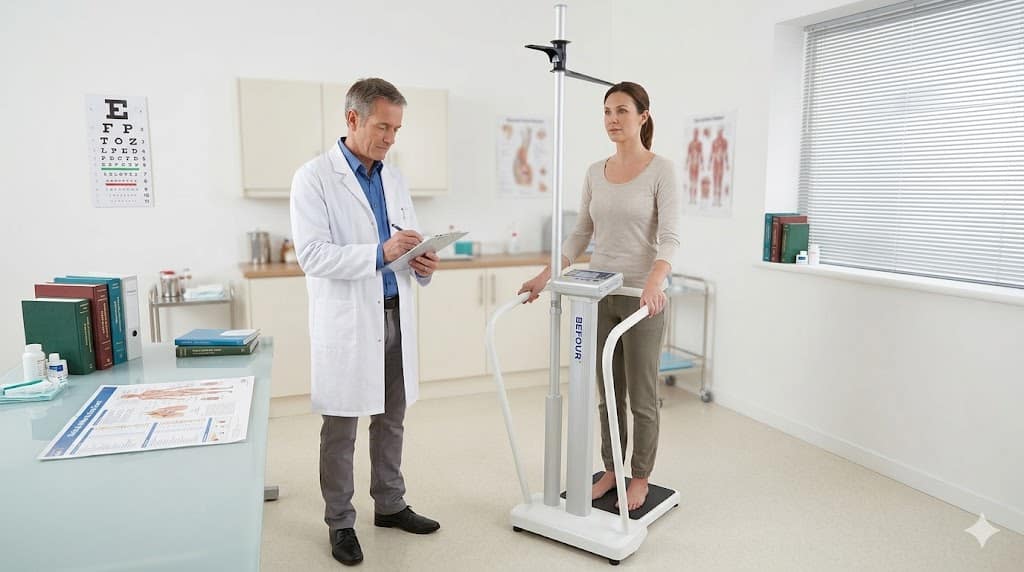
- Opti-Height Stadiometers: Integrated digital height rods ensure that both weight and height are captured simultaneously, streamlining the intake process.
- “Hands-Free” Operation: Features that allow for zeroing and weighing without the clinician touching the interface improve infection control protocols.
Compatibility across models
- Console & Interface: Staff should not feel as though they have entered a completely different environment when moving between scales. The console, interface, or operating system functions ought to remain consistent across all models.
Batteries
- Type & System: The selection of battery type and system is critical, given that some batteries are costly. If the batteries are rechargeable, frequent downtime may adversely affect patient care. It is advisable to choose a reliable system with cost-effective battery replacement options.
3. Important Advanced Functional Features
A professional-grade scale should have as prerequisite functions, a suite of “set-and-forget” advanced features to allow clinicians to focus on the patient, not the hardware:
- Adaptive Power Management: Programmable Auto-Off times (ranging from 12 seconds to 25 minutes) to preserve battery life based on ward traffic.
- Intelligent Zeroing: Automatic Zero, Recall, and Reweigh functions ensure that the scale is always ready for the next patient without manual recalibration.
- Global Standardization: Displays must toggle easily between pounds and kilograms, or be "locked-out" to display only one unit to comply with specific institutional safety protocols.
- Audible Feedback: An audible tone at weight lock-in confirms a successful reading in busy, noisy environments (with the option to program it off for quiet zones).
- EMR Connectivity: Eliminates manual transcription errors; ensures important measurements such as BMI is recorded instantly and accurately in the patient's digital file.

The Financial Reality: Total Cost of Acquisition (TCA)
A low-cost scale often becomes an expensive liability. Many experts agree that the first 3-year window is often critical to evaluate TCA and ROI. Such calculation should include:
- Purchase Price: Easy to figure out. Right?
- Assembly Time: Assembly time quickly increases if one or two inexperienced people are needed. Many facilities lack technical staff to assemble new equipment, and delays in setup can impact care.
- Maintenance Fees: Adhering to the manufacturer’s prescribed guidelines for preventive maintenance, coupled with diligent implementation of recommended procedures by facility personnel, directly influences the operational lifespan of the scale.
- Productivity Loss: This could be hard to measure but productivity suffers when equipment is out of commission because parts are backordered. It’s essential to select vendors with reliable supply chains and fast response times. Seek out those who have consistently performed well in your area.
- Interchangeable Display Console: This component is subject to frequent use and is therefore more prone to malfunction. Many manufacturers do not permit replacement of this part, instead requiring the purchase of an entirely new scale. It is advisable to prioritise this factor when selecting a scale, as the inability to replace a defective display or console can result in significant additional costs.
- Certification: This reflects a manufacturer’s quality and reliability. For example, ISO 13485 is the global standard for Quality Management Systems in the medical device sector, outlining requirements for design, manufacture, installation, and servicing to ensure safety and regulatory compliance.
- Battery Lifecycle: This is a big one. Certain batteries, such as lithium batteries, tend to be costly and may have a limited lifespan if not cared for properly from the outset. Other models using disposable batteries, can only do “25 hours of continuous operation” or about 1,500 measurements on one set of batteries, whereas others will do up to 100,000 weighing ON A SINGLE SET OF BATTERIES. Do the math…
- Warranty: An extensive initial manufacturer’s warranty that covers all components is a key indicator of the scale’s quality and durability. As a general guideline, a longer warranty period typically reflects greater confidence in product reliability.
What a 3-Year Scale TCA Equation Should Look Like:
Certain input factors in this equation may be challenging to quantify and can differ across facilities. Nonetheless, every value weight factor, or its absence, must be thoroughly documented as part of the TCA process.
{TCA} = {Purchase Price} + {Assembly Time} + {Maintenance Fees} + {Productivity Loss} + {Interchangeable Display Console} – {Certification} – {Battery Lifecycle} – {Warranty}

Summary
The right selection of professional healthcare scales is a strategic clinical decision.
By factoring in key evaluation metrics such as the clinical impact across the ‘’continuum of care’’, the engineering quality supported by reputable compliance authorities, the advanced functional features and a total cost of acquisition calculator, healthcare facilities can maximize patient care and minimize the long-term financial burden of equipment maintenance.
The table below is designed to serve as a Technical Compliance Matrix. It maps professional-grade features against the standard requirements often found in healthcare tenders, focusing on clinical outcomes and total cost of acquisition / ownership (TCA).
Technical Compliance Matrix: Professional Medical Scales
| Requirement Category | Standard Technical Specification | Clinical & Operational Impact |
|---|---|---|
| Construction & Durability | All-Metal Frame: Heavy-duty, powder-coated aluminum or steel construction (No plastic load-bearing parts). | Ensures a 20+ year useful life; prevents cracking and structural failure under high-capacity (Bariatric) loads. |
| Hygiene & Infection Control | Non-Porous Materials: Surfaces must be compatible with quaternary ammonium and bleach-based germicides. | Minimizes "microbe-friendly" zones; supports strict hospital disinfection protocols to prevent HAI (Healthcare-Associated Infections). |
| Measurement Accuracy | Motion-Sensing Technology: Software-based weight stabilization (e.g., Motionlock) to capture weight of unsteady patients. | Provides accurate readings on the first attempt for geriatric or pediatric patients, reducing re-weigh time and clinician stress. |
| Connectivity & EMR | Wireless Integration: Support for HL7-compliant data transfer via Wi-Fi or to Electronic Medical Records. | Eliminates manual transcription errors; ensures important measurements such as BMI are recorded instantly and accurately in the patient's digital file. |
| Integrated Assessment | Digital Stadiometer: Built-in digital height rod with automated BMI calculation capabilities. | Streamlines the intake process by capturing height and weight simultaneously without manual calculation. |
| Power Management | Long-Life Battery System: Low-power consumption circuitry with programmable "Auto-Off" (12s to 25m). | Minimizes the frequency of battery replacements; ensures the scale is operational in hallways or rooms without outlets. |
| User Interface | Universal Console: Standardized keypad and display across all models (Infant, Stand-on, Bariatric, Wheelchair). | Reduces staff training requirements and simplifies technical service/bio-med troubleshooting. |
| Specialized Clinical Use | Precision Fluid Tracking: "Milk Intake" or "Breastfeeding" measurement function (increments of 2g). | Critical for neonatal and pediatric wards to monitor nutritional progress in high-acuity infants. |
| Safety & Stability | High-Capacity / Low-Profile: Platforms designed with a low center of gravity and integrated safety handrails. | Minimizes fall risks for bariatric and mobility-impaired patients during the weighing procedure. |
| Quality Standards | ISO 13485 Certification: Manufacturer must be certified for medical device quality management systems. | Guarantees rigorous quality control, traceability, and long-term availability of replacement parts. |